Latin Phrases for Mottos, Names, and Creative Writing
Latin Phrase Guide
Latin phrases are often used for mottos, names, captions, fantasy writing, academic projects, roleplay, and worldbuilding because they feel concise, historic, and symbolic. A short Latin phrase can make a family motto sound formal, give a fictional kingdom more weight, or turn a simple idea like courage, truth, or hope into something more memorable.
The challenge is that Latin is not just English with older-looking words. Grammar, word endings, case, number, gender, and context can change the meaning of a phrase. That is why a phrase that looks elegant may still need checking before it is used for something permanent or formal.
This guide gives you practical Latin phrases, motto ideas, name inspiration, and usage notes. You can also use the Latin Translator to draft English to Latin phrases, compare meanings, and refine creative wording.
Latin phrases are commonly used for mottos, names, captions, stories, and symbolic wording. Short phrases usually work best because they are easier to remember and less likely to become grammatically awkward. Latin grammar and context matter, so important, academic, religious, legal, tattoo, or inscription text should be checked by a knowledgeable reviewer before final use.
Why Latin Works
Why Latin Phrases Are So Popular
Latin has a long association with history, law, education, religion, science, heraldry, and old institutions. That gives Latin phrases a serious and timeless tone, even when they are used in modern creative projects.
A phrase like “truth and courage” may sound simple in English, but a Latin-style version can feel more formal, symbolic, or ancient.
Mottos and Crests
Latin works well for family mottos, school mottos, club slogans, fantasy house words, and symbolic values.
Names and Titles
Use Latin-style words for kingdoms, guilds, orders, ships, teams, magical objects, and character titles.
Worldbuilding
Latin can make old laws, inscriptions, temples, royal banners, and scholarly traditions feel more grounded.
Latin also works well because many Latin words are short, strong, and visually memorable. Words like lux, veritas, virtus, spes, and gloria are easy to recognize and carry clear symbolic meaning.
Best Uses
Best Uses for Latin Phrases
Mottos
Latin phrases are excellent for mottos because mottos are usually short, formal, and memorable. Ideas like “always forward” or “strength and honor” work better than long modern sentences.
Names
Latin can inspire names for houses, orders, guilds, kingdoms, schools, ships, teams, or magical objects. Sometimes one strong noun or adjective is enough.
Creative Writing
Writers can use Latin phrases for ancient inscriptions, temple walls, secret orders, royal banners, magic systems, prophecy fragments, and scholarly dialogue.
Captions and Personal Projects
Short Latin phrases can work for captions, journals, usernames, project titles, or symbolic notes. For permanent use, accuracy matters more.
Short Phrases
Short Latin Phrases and Meanings
Short Latin phrases usually work better than long sentences. They are easier to read, easier to remember, and easier to style as mottos or names.
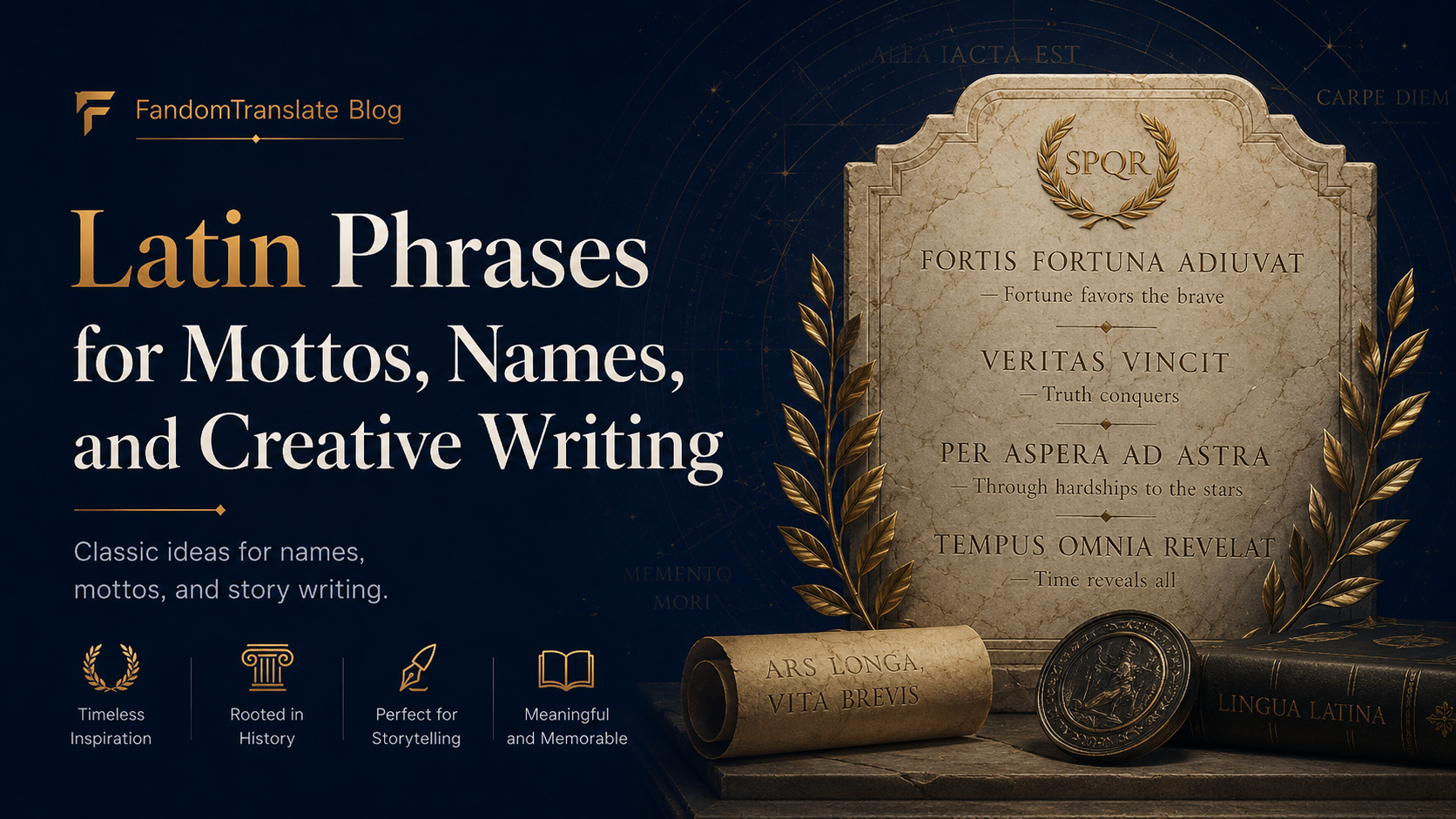
Lux et veritas
Light and truth
Spes manet
Hope remains
Semper prorsum
Always forward
Virtus et honor
Courage and honor
Ex astris
From the stars
Tempus revelat
Time reveals
These phrases are simple, but even simple Latin can depend on grammar and context. For example, a phrase used as a command may need a different form than a phrase used as a title.
Phrase Table
Latin Phrases Table
| English Idea | Latin Phrase | Meaning | Best Use | Accuracy / Style Note |
|---|---|---|---|---|
| courage | Virtus | Courage, virtue, strength of character | Motto, house value, character trait | A broad Latin word with moral and heroic meaning. |
| wisdom | Sapientia | Wisdom | School motto, scholar title, fantasy order | Simple noun form; works well as a symbolic title. |
| truth | Veritas | Truth | Motto, crest, faction value | Very recognizable and widely used; still clear. |
| light in darkness | Lux in tenebris | Light in darkness | Fantasy writing, symbolic motto | Strong phrase; context may affect exact wording. |
| strength and honor | Virtus et honor | Courage and honor | Warrior motto, team motto | “Virtus” can mean courage or excellence, not only physical strength. |
| always forward | Semper prorsum | Always forward | Personal motto, guild motto | Clean motto-style phrase. |
| from the stars | Ex astris | From the stars | Sci-fi fantasy, names, titles | Short and elegant; good for symbolic use. |
| remember the past | Memento praeterita | Remember past things | Historical motto, archive, kingdom lore | A more literal phrasing may vary by intended tone. |
| protect the realm | Regnum protege | Protect the kingdom | Fantasy house, royal guard, faction | Command form may vary depending on who is addressed. |
| victory through courage | Victoria per virtutem | Victory through courage | Warrior motto, faction motto | “Virtus” gives a classical heroic tone. |
| knowledge is power | Scientia potentia est | Knowledge is power | Scholar motto, academy, guild | A familiar structure; widely understandable. |
| peace through strength | Pax per fortitudinem | Peace through strength | Kingdom motto, political faction, story lore | “Fortitudo” suggests strength or firmness. |
| heart of fire | Cor ignis | Heart of fire | Character title, magic item, fantasy name | Compact phrase; poetic rather than a full sentence. |
| voice of the people | Vox populi | Voice of the people | Faction, council, rebellion motto | Established Latin phrase; use carefully if originality matters. |
| the old kingdom | Regnum antiquum | The ancient or old kingdom | Worldbuilding, map label, lore | Adjective agreement matters here. |
| born for glory | Natus ad gloriam | Born for glory | Hero title, motto, character arc | Masculine singular form; gender and number may change. |
| shadow and light | Umbra et lux | Shadow and light | Fantasy theme, duality, magic order | Simple symbolic pairing. |
| hope remains | Spes manet | Hope remains | Personal motto, story theme | Short, clear, and motto-friendly. |
| time reveals truth | Tempus veritatem revelat | Time reveals truth | Wisdom motto, mystery story | Word order can vary in Latin. |
| words have power | Verba vim habent | Words have power | Writer motto, magic system, scholar guild | “Vim” means force or power; context matters. |
| through hardship | Per aspera | Through difficulties | Personal motto, quest theme | Often used in longer motto structures. |
| light of wisdom | Lux sapientiae | Light of wisdom | Academy, library, magical order | Genitive form gives “of wisdom.” |
| guardian of peace | Custos pacis | Guardian of peace | Character title, order name | Singular form; plural would need adjustment. |
| fire and fate | Ignis et fatum | Fire and fate | Fantasy writing, prophecy, faction | Poetic phrase; not a complete sentence. |
Mottos
Latin Phrases for Mottos
A good Latin motto should be short, clear, and built around one strong idea. The best motto ideas usually focus on values such as courage, loyalty, wisdom, unity, honor, memory, truth, or hope.
A strong Latin motto should use simple wording, avoid modern slang, focus on one main idea, sound serious when read aloud, be easy to remember, and match the group, character, or project using it.
Motto Ideas
Motto Ideas Table
| Motto Goal | English Motto | Latin-Style Option | Best For | Note |
|---|---|---|---|---|
| family motto | Honor guides us | Honor nos ducit | Family crest, personal heritage project | Clear and formal; “us” makes it group-focused. |
| fantasy house motto | Fire remembers | Ignis meminit | Fantasy house, dragon family, ancient bloodline | Poetic and symbolic rather than everyday Latin. |
| school motto | Through wisdom, light | Per sapientiam lux | School, academy, library | Works well as a formal educational motto. |
| guild motto | Skill through discipline | Ars per disciplinam | Craft guild, fantasy guild, team | “Ars” can mean art, skill, or craft. |
| warrior motto | Courage conquers fear | Virtus timorem vincit | Warrior order, faction, character | Strong action-based phrasing. |
| scholar motto | Truth before glory | Veritas ante gloriam | Scholar order, academy, writer group | Formal and balanced. |
| kingdom motto | Peace by justice | Pax per iustitiam | Kingdom, council, royal banner | Good for political or noble worldbuilding. |
| personal motto | Always rise | Semper surge | Personal motto, character arc | Command form; tone is motivational. |
| team motto | Together we prevail | Una vincimus | Team, guild, party, group | “Una” means together; compact motto style. |
| story faction motto | We guard the old law | Legem antiquam custodimus | Secret order, royal guard, ancient faction | Longer, but useful for lore-heavy writing. |
| explorer motto | Beyond the known | Ultra nota | Exploration guild, sci-fi fantasy | Very compact; phrase is more stylistic. |
| rebel motto | Freedom remains | Libertas manet | Rebellion, resistance faction | Simple and strong. |
Name Ideas
Latin-Style Name Ideas
Latin names do not always need to be full translations. Many strong names come from one noun, one adjective, or a short noun phrase.
| Latin Word | Meaning | Good For |
|---|---|---|
| Lux | Light | Hero name, city name, magic source |
| Umbra | Shadow | Assassin guild, dark region, character name |
| Veritas | Truth | Academy, order, artifact |
| Spes | Hope | Rebellion, healer, sanctuary |
| Ignis | Fire | Dragon house, fire mage, weapon |
| Stella | Star | Ship name, kingdom, character |
| Silva | Forest | Region, clan, woodland faction |
| Ferrum | Iron | Fortress, warrior house, weapon |
| Corvus | Raven | Spy order, noble house, character |
| Aureus | Golden | Royal house, city, artifact |
Phrase Names
Latin Phrase Name Ideas
| Name Idea | Latin-Style Option | Best Use | Note |
|---|---|---|---|
| House of Light | Domus Lucis | Noble house, fantasy family | “Lucis” means “of light.” |
| Order of Truth | Ordo Veritatis | Knightly order, scholar group | Formal and serious tone. |
| Iron Crown | Corona Ferrea | Kingdom, relic, royal title | Adjective agreement matters. |
| Star Gate | Porta Stellarum | Portal, city gate, magic system | “Of the stars” gives a grand tone. |
| Black Forest | Silva Nigra | Region, setting, map label | Clear descriptive phrase. |
| Voice of Fire | Vox Ignis | Prophecy, magic order, title | Poetic and compact. |
| Sword of Dawn | Gladius Aurorae | Weapon name, legend, quest item | “Aurorae” means “of dawn.” |
| City of Hope | Urbs Spei | City name, sanctuary | Short and symbolic. |
Worldbuilding
Latin for Fantasy Writing and Worldbuilding
Latin works especially well in fantasy because it already feels ancient to many readers. It can make a fictional world feel connected to old empires, lost religions, scholarly orders, royal houses, or magical traditions.
Where Latin-style phrases fit
Use them for inscriptions, ancient laws, royal mottos, magical commands, academy names, secret order titles, prophecy fragments, old kingdom names, and artifact names.
Keep the world consistent
Do not mix Latin randomly with unrelated fantasy words unless there is a reason inside the story. Consistency makes the language feel intentional instead of decorative.
Clean Style
How to Make Latin Phrases Sound Clean and Serious
A clean Latin phrase usually starts with a simple English idea. Before translating, reduce the phrase to its core meaning.
Instead of a long sentence
“We never stop fighting for the honor of our ancient kingdom.”
Try a shorter idea
Honor endures
We guard the kingdom
Courage never falls
The old kingdom stands
Short phrases are easier to translate, easier to check, and stronger as mottos.
Grammar
Why Grammar and Context Matter in Latin
Latin uses word endings to show how words function in a sentence. This means a Latin phrase can change depending on who is acting, what is being acted on, and whether the phrase refers to one person, many people, a masculine noun, a feminine noun, or a neuter noun.
For example, a phrase meaning “born for glory” may change depending on whether it describes a man, woman, group, house, or object. A motto written as a command may use a different verb form than a statement.
Case
Shows whether a word is the subject, object, possession, direction, and more.
Number
Singular and plural forms can differ.
Gender
Masculine, feminine, and neuter forms can affect adjectives and participles.
Verb form
Commands, statements, and descriptions may use different forms.
This does not mean beginners cannot use Latin phrases. It means important phrases should be checked before final use.
Main Tool
When to Use a Latin Translator
Use the Latin Translator when you want to draft English to Latin phrases, check Latin to English meanings, create motto ideas, test name concepts, or compare different wording styles.
Good for drafts
Use it for English to Latin phrases, Latin phrases with meaning, short motto ideas, Latin names, captions, and symbolic wording.
Review important text
For academic, religious, legal, official, tattoo, inscription, or permanent text, use translator output as a draft and get expert review.
Expert Review
When to Get Expert Review
Some uses need more care than others. You should get a knowledgeable Latin reviewer when the phrase will be permanent, formal, public, or difficult to change later.
Get expert review for tattoos, memorial text, inscriptions, academic work, religious wording, legal or official use.
Review brand names, published books, and historical projects where accuracy matters.
For casual worldbuilding, usernames, captions, drafts, or private notes, a Latin-style phrase may be enough.
Mistakes
Common Mistakes With Latin Phrases
| Mistake | Why It Happens | Better Approach |
|---|---|---|
| Translating word by word | Users copy English structure directly into Latin. | Start with a simple idea, then translate the meaning. |
| Ignoring grammar case | Latin word endings change based on function. | Check whether a word is subject, object, possession, or direction. |
| Ignoring gender and number | Adjectives and some forms must match nouns. | Decide if the phrase describes one person, many people, a house, or an object. |
| Using long modern idioms | Modern sayings often do not map cleanly into Latin. | Convert the idea into a shorter, clearer phrase. |
| Trusting a phrase for tattoos or inscriptions without review | Permanent text is hard to fix later. | Use translator output as a draft and ask a qualified reviewer. |
| Mixing Latin with fantasy words randomly | It can make the worldbuilding feel inconsistent. | Create a reason for Latin-style language inside the story. |
| Assuming all famous Latin quotes fit any context | Famous quotes may have specific historical or grammatical settings. | Choose a phrase that matches your exact meaning. |
| Treating Latin-style output as academically verified | Tools can help draft but may not guarantee classical accuracy. | Use expert review for academic or formal use. |
| Using modern slang directly | Slang often loses meaning when translated literally. | Rewrite slang into a timeless idea first. |
| Choosing words only because they look cool | Attractive words may not mean what users think. | Check the meaning and usage before finalizing. |
Practical Tips
Tips for Creating Better Latin Phrases
Keep phrases short and start with clear English.
Avoid slang, modern idioms, and long sentences forced into motto form.
Decide if you want a classical, motto-style, or fantasy-inspired tone.
Use nouns and verbs carefully, and check important phrases before permanent use.
Use the Latin Translator for drafts, then translate back to check meaning.
Save multiple versions before choosing one, and keep names easy to read and remember.
Prefer strong ideas like truth, courage, hope, light, honor, wisdom, memory, and victory.
Use Latin-style wording as inspiration, not automatic proof of accuracy.
Related Tools
Related Translator Links
Latin Translator
Create and refine Latin phrases, meanings, names, mottos, and creative wording.
Old English Translator
Useful for Anglo-Saxon-inspired names, old kingdoms, and historical fantasy tone.
Middle English Translator
Good for medieval-style dialogue, names, and literary atmosphere.
Shakespearean Translator
Helps create dramatic, poetic, and early modern English-style lines.
Historical Language Translators
Explore multiple old-language styles for stories, names, and worldbuilding.
Fictional Language Translators
Try fantasy, sci-fi, fandom, and invented-language styles for creative projects.
FAQs
FAQs About Latin Phrases
What are Latin phrases used for?
Latin phrases are used for mottos, names, captions, academic references, creative writing, fantasy worldbuilding, roleplay, symbolic wording, and historical-style projects. They are popular because they sound formal, concise, and timeless.
What is a good short Latin phrase?
A good short Latin phrase is simple, clear, and easy to remember. Examples include Spes manet for “hope remains,” Lux et veritas for “light and truth,” and Semper prorsum for “always forward.”
Can I use Latin phrases for mottos?
Yes, Latin phrases work well for mottos because mottos are usually brief and symbolic. The best motto phrases focus on one idea, such as courage, truth, unity, wisdom, honor, or hope.
Can I use Latin phrases for names?
Yes, Latin can inspire names for houses, kingdoms, guilds, teams, characters, artifacts, cities, and fantasy locations. One-word names like Lux, Umbra, Veritas, or Ignis can work well when the meaning fits the project.
Are online Latin translations always accurate?
No. Online Latin translations can be useful for drafts and inspiration, but they may not always handle grammar, case, gender, number, or context perfectly. Important phrases should be reviewed before final use.
Why does Latin grammar matter?
Latin grammar matters because word endings can change meaning. A phrase may need different forms depending on whether it describes one person, a group, an object, a command, a title, or a complete sentence.
Can I use Latin for fantasy writing?
Yes, Latin is useful for fantasy writing, especially for ancient kingdoms, old laws, magical orders, inscriptions, prophecies, and scholarly traditions. It works best when the language style has a clear role in the worldbuilding.
Should I check Latin before using it for tattoos or inscriptions?
Yes. Tattoos, inscriptions, memorials, official names, and permanent text should be checked by someone knowledgeable in Latin. A translator can help create a draft, but permanent wording needs extra care.
What is the best way to translate English to Latin?
Start with a clear, simple English phrase. Avoid slang and long idioms. Use a Latin translator to create draft options, translate them back to check the meaning, then get expert review for important or permanent use.
Is Latin good for worldbuilding?
Latin is very useful for worldbuilding because it can suggest history, empire, scholarship, religion, law, magic, or ancient tradition. It is strongest when used consistently and not mixed randomly with unrelated language styles.
Create a Latin Phrase for Your Project
Create your own motto, name, caption, or story phrase with the Latin Translator. Try a few short versions, compare the meanings, and refine the phrase until it fits your project.
Try the Latin Translator →