Morse Code Alphabet, Numbers, and Examples for Beginners
Morse Code Learning Guide
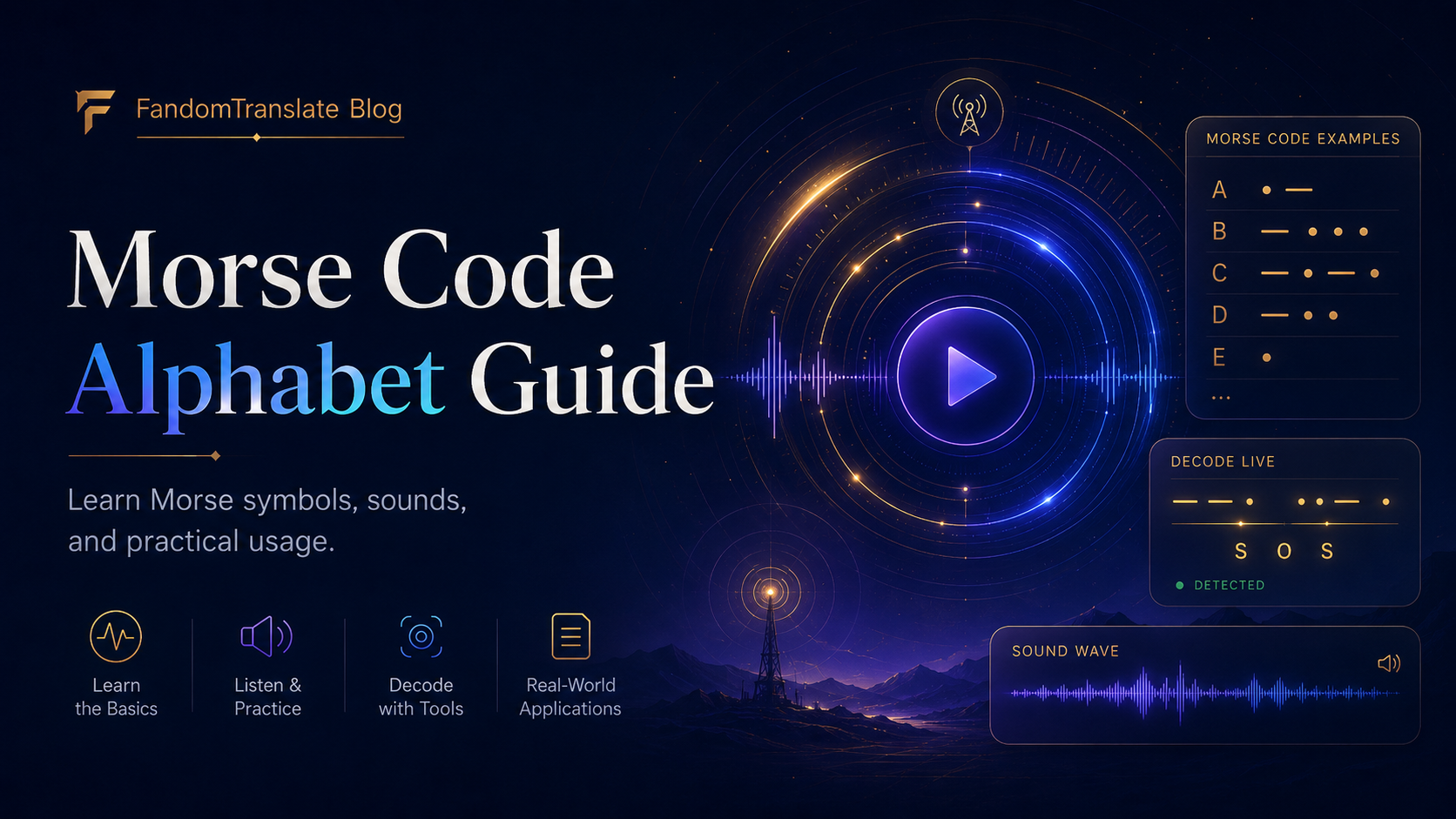
The Morse code alphabet is a system that represents letters, numbers, and some punctuation marks with short and long signals called dots and dashes. Each letter from A to Z has its own pattern, such as A = .-, B = -…, and S = ….
This guide gives you a complete Morse code alphabet chart, number chart, examples, spacing rules, common mistakes, and beginner practice tips. It is designed for reading and learning, not just converting text instantly.
For faster work, you can use the Morse Code Translator to convert text to Morse, decode Morse back to English, play Morse audio, adjust speed, control spacing, and practice with your own words.
The Morse code alphabet uses dots and dashes to represent letters, numbers, and some punctuation. Each letter and number has a unique pattern, such as S = …, O = —, and 1 = .—-. You can read Morse code visually, encode text into signals, decode signals into English, or practice with audio to learn the rhythm.
Basics
What Is the Morse Code Alphabet?
The Morse code alphabet is a communication system where letters are written as combinations of dots and dashes.
Dot
A dot is a short signal. In written Morse code, it is shown as .
Dash
A dash is a longer signal. In written Morse code, it is shown as –
Pattern
Dots and dashes combine to form letters, numbers, punctuation, and signals.
Morse code can be shown as written text, heard as sound, flashed as light, tapped, or sent as radio signals. Today, many people learn it for education, amateur radio, puzzles, games, and creative code-based messages.
Search Intent
Why People Search for the Morse Code Alphabet
Most users searching for the Morse code alphabet want a chart, a decoder, examples, or beginner practice material. This article focuses on learning and reference. For instant conversion, use a translator tool after you understand the basics.
- A chart of Morse code letters A to Z
- Morse code numbers from 0 to 9
- Easy examples like SOS, HELP, and HELLO
- A way to decode dots and dashes
- Practice material for students or beginners
- Puzzle clues for escape rooms, games, or worksheets
- Audio practice to learn the sound of each pattern
Signals
How Dots and Dashes Work in Morse Code
| Symbol | Name | Meaning |
|---|---|---|
| . | Dot | A short signal |
| – | Dash | A longer signal |
| Letter | Morse Code | How to Read It |
|---|---|---|
| E | . | dot |
| T | – | dash |
| A | .- | dot dash |
| M | — | dash dash |
| S | … | dot dot dot |
| O | — | dash dash dash |
Alphabet Chart
Morse Code Alphabet Chart A to Z
Use this Morse code alphabet chart to learn letters, decode messages, or create practice words.
| Letter | Morse Code | Simple Memory Hint |
|---|---|---|
| A | .- | Starts short, ends long |
| B | -… | One dash followed by three dots |
| C | -.-. | Dash-dot pattern repeats |
| D | -.. | Dash with two dots |
| E | . | The shortest letter |
| F | ..-. | Two dots, dash, dot |
| G | –. | Two dashes, then dot |
| H | …. | Four quick dots |
| I | .. | Two quick dots |
| J | .— | One dot, then three dashes |
| K | -.- | Dash, dot, dash |
| L | .-.. | Dot, dash, two dots |
| M | — | Two dashes |
| N | -. | Dash, then dot |
| O | — | Three long dashes |
| P | .–. | Dot, two dashes, dot |
| Q | –.- | Two dashes, dot, dash |
| R | .-. | Dot, dash, dot |
| S | … | Three quick dots |
| T | – | One dash |
| U | ..- | Two dots, then dash |
| V | …- | Three dots, then dash |
| W | .– | Dot, then two dashes |
| X | -..- | Dash, two dots, dash |
| Y | -.– | Dash, dot, two dashes |
| Z | –.. | Two dashes, two dots |
Numbers
Morse Code Numbers Chart 0 to 9
Morse code numbers follow a clear pattern. Numbers from 1 to 5 begin with dots, while numbers from 6 to 0 begin with dashes.
| Number | Morse Code | Pattern Note |
|---|---|---|
| 0 | —– | Five dashes |
| 1 | .—- | One dot, four dashes |
| 2 | ..— | Two dots, three dashes |
| 3 | …– | Three dots, two dashes |
| 4 | ….- | Four dots, one dash |
| 5 | ….. | Five dots |
| 6 | -…. | One dash, four dots |
| 7 | –… | Two dashes, three dots |
| 8 | —.. | Three dashes, two dots |
| 9 | —-. | Four dashes, one dot |
Punctuation
Common Morse Code Punctuation
Morse code can also represent punctuation. You do not need to memorize all punctuation at first, but these are useful for messages, worksheets, and puzzle clues.
| Punctuation | Morse Code | Use |
|---|---|---|
| Period . | .-.-.- | End of a sentence |
| Comma , | –..– | Pause in a sentence |
| Question mark ? | ..–.. | Questions |
| Apostrophe ‘ | .—-. | Contractions or names |
| Exclamation mark ! | -.-.– | Emphasis |
| Slash / | -..-. | Separating terms |
| Parentheses ( | -.–. | Opening bracket |
| Parentheses ) | -.–.- | Closing bracket |
| Colon : | —… | Labels or times |
| Hyphen – | -….- | Compound words |
Spacing
How Spacing Works Between Letters and Words
Spacing is one of the most important parts of reading Morse code. Without spacing, letters can become confusing.
| Level | Written Example | Meaning |
|---|---|---|
| Inside a letter | … | Dots and dashes form one letter |
| Between letters | … — … | Spaces separate letters |
| Between words | …. . .-.. .–. / — . | Slash separates words in written Morse |
A common written format uses one space between letters and a slash between words. For example, HELP ME becomes …. . .-.. .–. / — .. Without separators, the message becomes much harder to decode.
Reading Practice
How to Read Morse Code Examples
The easiest way to read Morse code is to split the message into groups.
Example: …. . .-.. .-.. —
| Morse Group | Letter |
|---|---|
| …. | H |
| . | E |
| .-.. | L |
| .-.. | L |
| — | O |
So the full message is HELLO. A longer phrase like — — .-. … . / -.-. — -.. . breaks into MORSE and CODE.
Examples
Morse Code Examples Table
| Plain Text | Morse Code | Best Use | Note |
|---|---|---|---|
| SOS | … — … | Emergency signal practice | One of the most famous Morse patterns |
| HELLO | …. . .-.. .-.. — | Beginner greeting | Good for learning repeated letters |
| LOVE | .-.. — …- . | Short message | Mixes short and longer patterns |
| HELP | …. . .-.. .–. | Puzzle clue | Easy word with clear spacing |
| YES | -.– . … | Simple answer | Useful for quick response practice |
| NO | -. — | Simple answer | Very short and easy to decode |
| START | … – .- .-. – | Game instruction | Good for escape room clues |
| STOP | … – — .–. | Signal word | Classic command-style word |
| CODE | -.-. — -.. . | Learning example | Uses common beginner letters |
| GAME | –. .- — . | Gamer clue | Useful for puzzle intros |
| SECRET | … . -.-. .-. . – | Hidden message | Strong choice for worksheets |
| MESSAGE | — . … … .- –. . | Longer practice | Good for spacing and repeated letters |
| MORSE CODE | — — .-. … . / -.-. — -.. . | Topic phrase | Shows word separation |
| FANDOM | ..-. .- -. -.. — — | Site-related example | Good for creative practice |
| TRANSLATE | – .-. .- -. … .-.. .- – . | Tool-related example | Longer word with mixed patterns |
Audio
How Morse Audio Helps You Learn Rhythm
Morse code is not only a visual code. It was designed to be heard as a rhythm. A dot sounds short, and a dash sounds longer.
For example, S sounds like three short beats: dot dot dot. O sounds like three longer beats: dash dash dash. SOS has a memorable rhythm: short short short, long long long, short short short.
| Learning Method | Strength | Limitation |
|---|---|---|
| Visual chart | Good for memorizing letters | Can become slow if you count symbols |
| Written examples | Good for decoding practice | Spacing mistakes are easy |
| Audio playback | Builds rhythm recognition | Needs slow speed at first |
| Translator practice | Checks your work quickly | Best used with active learning |
Audio practice helps because your brain starts recognizing patterns by sound instead of counting every dot and dash.
Practice
How to Practice Morse Code
Start small. Do not begin with long paragraphs.
Learn the shortest letters first: E, T, I, M, A, and N.
Practice famous signals like SOS.
Use audio playback to hear the rhythm.
Increase speed only when the patterns feel familiar.
| Word | Morse Code | Why It Helps |
|---|---|---|
| ME | — . | Very short |
| IT | .. – | Uses simple letters |
| NO | -. — | Easy answer word |
| YES | -.– . … | Good short challenge |
| HELP | …. . .-.. .–. | Useful and recognizable |
| CODE | -.-. — -.. . | Great for code learners |
Main Tool
How to Use the Morse Code Translator for Encoding and Decoding
A chart is best for learning. A translator is best for speed, checking, and practice.
Convert and decode
Use the Morse Code Translator to convert English text to Morse code or decode Morse code back into English.
Hear audio rhythm
Play Morse code audio, adjust speed, control spacing, and practice with your own examples.
Try typing SECRET MESSAGE, convert it into Morse, listen to the rhythm, then decode it again without looking at the plain text.
Learning Tips
Tips for Learning Morse Code Faster
Start with short words like NO, YES, SOS, and HELP.
Learn common letters first, especially E, T, A, O, I, and N.
Use audio playback to hear the difference between dots and dashes.
Adjust speed slowly instead of starting fast.
Separate letters clearly and use a slash between words.
Use the Morse Code Translator to check your work.
Mistakes
Common Mistakes Beginners Make
| Mistake | Why It Happens | Better Approach |
|---|---|---|
| Mixing up dots and dashes | Beginners focus on shape instead of rhythm | Say “dot” and “dash” aloud while practicing |
| Ignoring spacing between letters | Users write Morse as one long string | Add one space between each letter |
| Ignoring spacing between words | Word breaks disappear | Use / between words |
| Typing Morse without separators | Letter boundaries become unclear | Write …. . .-.. .–. instead of one long string |
| Confusing similar letters | Letters like S, H, V, and B look related | Practice similar groups together |
| Reading too fast | Users try to decode whole messages immediately | Decode one group at a time |
| Not using audio rhythm | Visual practice alone can feel slow | Listen to Morse audio at a low speed |
| Assuming Morse code is encryption | Morse is a code, not secure encryption | Treat it as a communication system, not privacy protection |
| Using long messages too early | Long strings create spacing errors | Start with short words and names |
Puzzles
Morse Code for Puzzle Clues and Games
Morse code is useful for escape rooms, treasure hunts, classroom worksheets, and game clues because it looks mysterious but can be solved with a chart.
| Puzzle Phrase | Morse Code | Puzzle Use |
|---|---|---|
| FIND KEY | ..-. .. -. -.. / -.- . -.– | Escape room clue |
| OPEN DOOR | — .–. . -. / -.. — — .-. | Lock or room clue |
| START GAME | … – .- .-. – / –. .- — . | Intro clue |
| SECRET CODE | … . -.-. .-. . – / -.-. — -.. . | Hidden message |
| GO NORTH | –. — / -. — .-. – …. | Direction clue |
For puzzles, always provide either a Morse code chart or enough clues for players to solve the message fairly.
Related Tools
Related Translator Links
Morse Code Translator
Convert text to Morse, decode Morse, hear audio, and practice spacing.
Binary Translator
Turn text into binary code or decode binary back into readable text.
Symbol Translator
Create symbol-based text for fun messages, names, and decorative styles.
Wingdings Translator
Convert text into Wingdings-style symbols for puzzles or visual codes.
Upside Down Text Translator
Flip text upside down for social posts, games, and hidden-style messages.
Codes & Symbols Translators
Explore multiple code, symbol, and text transformation tools in one place.
FAQs
FAQs
What is the Morse code alphabet?
The Morse code alphabet is a system that represents letters with dots and dashes. Each letter from A to Z has its own pattern, such as A = .-, B = -…, and C = -.-..
How many letters are in Morse code?
The Morse code alphabet includes all 26 English letters from A to Z. Morse code also includes numbers from 0 to 9 and several punctuation marks.
What is SOS in Morse code?
SOS in Morse code is … — …. It is easy to recognize because it has three dots, three dashes, and three dots.
How do Morse code numbers work?
Morse code numbers use five symbols each. For example, 1 is .—-, 5 is ….., and 0 is —–. Numbers follow a pattern from dots to dashes and then dashes to dots.
What is the difference between dots and dashes?
A dot is a short signal, and a dash is a longer signal. In written Morse code, dots are shown as . and dashes are shown as -.
How do you separate Morse code letters?
In written Morse code, letters are usually separated by spaces. For example, HELLO is written as …. . .-.. .-.. —.
How do you separate Morse code words?
Words are commonly separated with a slash / in written Morse code. For example, MORSE CODE is written as — — .-. … . / -.-. — -.. ..
Is Morse code hard to learn?
Morse code is not hard to start learning, but it takes practice to read quickly. Beginners should start with short letters, simple words, and slow audio playback.
Can I listen to Morse code audio?
Yes. Morse code can be learned by sound, and audio practice helps you recognize rhythm. A translator with audio playback can help you hear dots, dashes, speed, and spacing more clearly.
Is Morse code a secret code?
Morse code is a communication code, not secure encryption. Anyone who knows the chart can decode it, so it should not be used for private or sensitive information.
Practice Morse Code Online
Use the Morse Code Translator to encode text, decode Morse code, listen to audio, adjust speed, control spacing, and practice with your own examples.
Try the Morse Code Translator →