Old English, Middle English, and Shakespearean English Compared
Historical English Guide
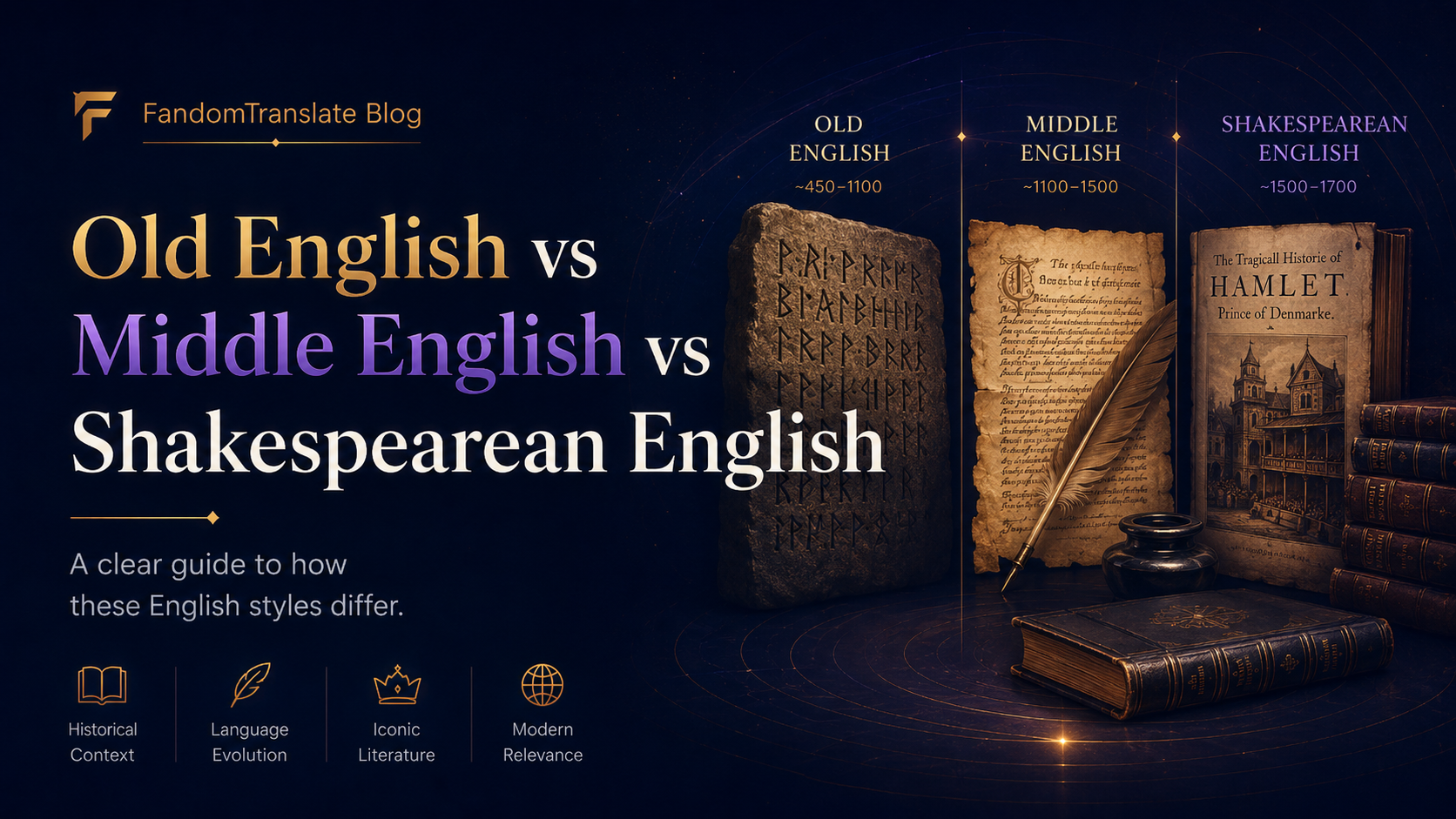
Old English, Middle English, and Shakespearean English are not the same form of English. They belong to different stages of the language, and each one has its own spelling, grammar, vocabulary, sound, and cultural setting.
Old English is the earliest and most unfamiliar to modern readers. Middle English is the medieval stage often linked with Chaucer. Shakespearean English belongs to Early Modern English, which is much closer to the language used today.
This confusion is common because people often use “Old English” to mean any English that sounds old, poetic, or dramatic. In reality, a Beowulf-style phrase, a Chaucer-style sentence, and a Shakespeare-style line are very different. This guide explains the main differences in a beginner-friendly way and helps you choose the right tool from the Historical Language Translators collection.
Old English is the earliest form of English and is also called Anglo-Saxon English. Middle English came later and is associated with medieval English and writers like Chaucer. Shakespearean English is Early Modern English, not Old English. Because each style belongs to a different period, users should choose a different translator tool for each one.
Old English
What Is Old English?
Old English is the earliest major stage of the English language. It was used in Anglo-Saxon England and looks very different from the English most people read today. It includes letters and sounds that are no longer common in modern English, such as þ and ð, and its grammar is much more complex.
Old English is often connected with works like Beowulf, Anglo-Saxon poetry, early English religious writing, and historical texts from before the Norman Conquest. For modern readers, it can feel almost like a separate language.
What it looks like
Old English is not simply modern English with old spellings. It has different vocabulary, word endings, and sentence structure.
When to use it
Use Old English style for Anglo-Saxon, early medieval, Beowulf-inspired writing, names, lore fragments, or historical comparison.
For creative Old English-style wording, use the Old English Translator.
Middle English
What Is Middle English?
Middle English came after Old English and before Early Modern English. It developed after major historical changes, including Norman French influence, and it is often associated with medieval England.
The most famous literary name connected with Middle English is Geoffrey Chaucer, especially The Canterbury Tales. Middle English is easier for modern readers than Old English, but it can still be challenging because spellings, vocabulary, and grammar were not yet modern.
What it looks like
Middle English often feels partly familiar and partly strange. Some words look close to modern English, while others use older spellings or meanings.
When to use it
Use Middle English style for medieval fiction, Chaucer-inspired examples, knights, castles, old roads, and manuscript-style writing.
For this type of wording, use the Middle English Translator.
Shakespearean English
What Is Shakespearean English?
Shakespearean English belongs to Early Modern English. It is much closer to modern English than Old English or Middle English, but it still uses older grammar, vocabulary, rhythm, and sentence patterns.
William Shakespeare wrote during the Early Modern English period, not the Old English period. That means Shakespeare’s language is old compared with modern English, but it is not “Old English” in the historical sense.
What it looks like
Shakespearean English may include words like thou, thee, thy, hath, doth, wherefore, and art, along with poetic phrasing.
When to use it
Use Shakespearean style for theatrical dialogue, dramatic messages, royal speeches, fantasy nobles, bards, and playful captions.
For this style, use the Shakespearean Translator.
Key Differences
Why Shakespearean English Is Not Old English
Shakespearean English is not Old English because it belongs to a much later period. Old English is the language of Anglo-Saxon England. Shakespeare wrote in Early Modern English, which is far closer to the English used today.
The confusion happens because many people use “Old English” casually to mean “English that sounds old.” In language history, however, Old English has a specific meaning. It refers to the earliest stage of English, not every historical or fancy-sounding style.
A sentence with thee, thou, or hath may sound old-fashioned, but those words do not automatically make it Old English. They are more closely associated with Early Modern English and Shakespeare-style writing.
Medieval vs Dramatic
Why Middle English Is Not the Same as Shakespearean English
Middle English and Shakespearean English are also different. Middle English is the medieval stage of English, while Shakespearean English is Early Modern English.
Middle English is linked with Chaucer, medieval manuscripts, and a period when English spelling and vocabulary were still heavily changing. Shakespearean English came later, when English was becoming much more recognizable to modern readers.
A Middle English-style sentence may feel rougher, more medieval, and less standardized. A Shakespearean-style sentence often feels more dramatic, poetic, and theatrical.
Difficulty
Why Old English Is Much Harder for Modern Readers
Old English is usually the hardest of the three because it differs from modern English in deeper ways. It is not only the spelling that changed. The grammar, word forms, vocabulary, and sentence patterns were also very different.
Modern readers may find Shakespeare difficult, but they can often understand parts of it. Middle English can be harder, but many words still look familiar. Old English usually requires special study because many common words are unfamiliar or have changed completely.
This is why Old English should not be treated as a simple “old font” or “old spelling” version of modern English. It is a much earlier language stage.
Language Change
How English Changed Over Time
Spelling
Old English used letters modern English no longer uses regularly. Middle English spelling varied widely. Shakespearean English was closer to modern spelling but still flexible.
Vocabulary
Old English had many Germanic words. Middle English absorbed French and Latin influence. Shakespearean English included many words still used today, but meanings could differ.
Grammar
Old English used more word endings. Middle English reduced many endings. Shakespearean English still used older pronouns and verb forms such as thou art and he hath.
Pronunciation
Pronunciation changed greatly across all periods. Old English, Middle English, Shakespearean English, and modern English did not sound the same.
Comparison
Main Comparison Table
| English Type | Time Period | Famous Association | How It Looks to Modern Readers | Best Tool to Use | Key Difference |
|---|---|---|---|---|---|
| Old English | c. 450–1100 | Anglo-Saxon England, Beowulf | Often very difficult, sometimes almost unreadable without study | Old English Translator | Earliest stage of English with very different grammar and vocabulary |
| Middle English | c. 1100–1500 | Chaucer, medieval England, The Canterbury Tales | Partly familiar but still strange and inconsistent | Middle English Translator | Medieval English between Anglo-Saxon and Early Modern English |
| Shakespearean English | c. 1500–1700 | Shakespeare, theatre, Early Modern English | Mostly recognizable but old-fashioned and poetic | Shakespearean Translator | Early Modern English, not Old English |
| Modern English | c. 1700–present | Current English writing and speech | Familiar to modern readers | Modern writing tools | Standard English used today |
Examples
Examples Table
These examples are beginner-friendly style examples, not academically verified historical translations. Real historical wording can vary by dialect, period, spelling, and context.
| Modern English Idea | Old English-Style Example | Middle English-Style Example | Shakespearean-Style Example | Note |
|---|---|---|---|---|
| Hello | Wes hāl | Hail | Good morrow | Greetings changed across periods and regions |
| Good morning | Gōdne morgen | Good morwe | Good morrow, fair friend | Shakespearean style often sounds more dramatic |
| My friend | Mīn frēond | Min frend | My good friend | Old English uses older forms and spelling |
| I love you | Ic lufie þē | I love thee | I do love thee | “Thee” is not Old English by itself |
| The king is wise | Se cyning is wīs | The king is wys | The king is wise indeed | Old English grammar is much less modern |
| The knight rides | Se cniht rītt | The knight rideth | The knight doth ride | “Doth” is more Early Modern in style |
| Be brave | Bēo cēne | Be bold | Be thou brave | Shakespearean style often uses “thou” forms |
| The old kingdom | Þæt ealde rīce | The olde kingdom | The ancient kingdom | “Old-looking” spelling alone is not enough |
| The moon is bright | Se mōna is beorht | The mone is bright | The moon shines bright | Shakespearean style often adds poetic rhythm |
| We are one | Wē sind ān | We ben oon | We are but one | Middle English forms can vary widely |
Timeline
Simple Timeline of Historical English
Dates are approximate. English changed gradually, and different regions changed at different speeds.
Old English
Old English was used in Anglo-Saxon England. It is the earliest major stage of English and is connected with early medieval England, Germanic vocabulary, and texts such as Beowulf.
Middle English
Middle English came after Old English. It is associated with medieval England and Chaucer, and it shows strong changes in vocabulary, spelling, and grammar.
Early Modern English and Shakespearean English
Early Modern English came after Middle English. Shakespeare wrote during this period. This style is much closer to modern English but still uses older pronouns, verb forms, and poetic phrasing.
Modern English
Modern English is the form of English used today. It has more standardized spelling, grammar, and vocabulary than earlier periods, though it still varies by region and context.
Mistakes
Common Mistakes Users Make
| Mistake | Why It Happens | Better Approach |
|---|---|---|
| Calling Shakespeare Old English | Shakespeare sounds old-fashioned to modern readers | Call it Shakespearean English or Early Modern English |
| Confusing Middle English with Old English | Both are historical and medieval-looking | Remember that Old English is earlier and much harder to read |
| Thinking “thee” and “thou” make text Old English | These words feel old and formal | Use them for Shakespearean or Early Modern style, not Old English |
| Using random old-looking spelling | Words like “olde” can make text look historical | Choose a specific period instead of mixing styles |
| Treating historical-style output as academically verified | Translators are often style tools, not scholarly editions | Review important work with reliable academic sources |
| Using translator output for tattoos, inscriptions, or formal projects without review | Short phrases can be context-sensitive | Get expert review before permanent or formal use |
| Confusing historical English with fantasy language | Fantasy writing often borrows medieval sounds | Keep historical English separate from fictional languages |
| Mixing Old English, Middle English, and Shakespearean English in one sentence | All three sound “old” to beginners | Pick one style based on the period and tone you want |
| Assuming one translator can cover every historical period | Each style has different grammar and vocabulary | Use the translator designed for that period |
| Believing modern slang can be converted perfectly | Historical styles may not have direct equivalents | Keep phrases simple and avoid modern idioms |
Choosing a Style
Tips for Choosing the Right Historical English Style
Use Old English for Anglo-Saxon or Beowulf-style inspiration, early medieval atmosphere, and ancient English tone.
Use Middle English for medieval or Chaucer-style wording, knights, castles, pilgrim stories, and manuscript-inspired text.
Use Shakespearean English for dramatic Early Modern English style, theatre-like dialogue, poetic messages, nobles, and bards.
Keep phrases short because historical-style translators usually work better with simple sentences than long modern paragraphs.
Avoid modern slang and do not mix all styles randomly in one sentence.
Review historical text before academic, formal, tattoo, inscription, or permanent use because grammar, spelling, dialect, and context can matter.
Tool Choice
Which Translator Should You Use?
Use the Old English Translator for Anglo-Saxon Style
Choose the Old English Translator when you want early English, Anglo-Saxon wording, or a Beowulf-like atmosphere.
Use the Middle English Translator for Medieval Style
Choose the Middle English Translator for Chaucer-inspired writing, knightly phrases, and old manuscript tones.
Use the Shakespearean Translator for Dramatic Early Modern Style
Choose the Shakespearean Translator when you want poetic, theatrical, dramatic, or Shakespeare-inspired phrasing.
Related Tools
Related Translator Links
Old English Translator
Use it for Anglo-Saxon, early English, and Beowulf-style inspiration.
Middle English Translator
Use it for medieval, Chaucer-style, and knightly wording.
Shakespearean Translator
Use it for dramatic Early Modern English and theatre-like phrasing.
Latin Translator
Use it for classical, scholarly, Roman, or motto-style wording.
Historical Language Translators
Browse historical-style tools in one place.
Fun Translators
Try playful, fandom, symbol, and creative text styles.
FAQs
FAQs
Is Shakespearean English Old English?
No. Shakespearean English is Early Modern English, not Old English. Old English is the much earlier Anglo-Saxon stage of the language, while Shakespeare wrote centuries later.
Is Middle English the same as Shakespearean English?
No. Middle English came before Shakespearean English. Middle English is linked with medieval English and Chaucer, while Shakespearean English belongs to Early Modern English.
What is the main difference between Old English and Middle English?
Old English is earlier, more Germanic, and much harder for modern readers. Middle English came later and includes many changes in spelling, grammar, and vocabulary.
Which came first, Old English or Middle English?
Old English came first. Middle English developed after Old English and before Early Modern English.
What kind of English did Shakespeare write in?
Shakespeare wrote in Early Modern English. His language is older than modern English but still much closer to modern English than Old English is.
Can modern English speakers read Old English?
Most modern English speakers cannot easily read Old English without study. It has unfamiliar grammar, vocabulary, spelling, and letters.
Is Chaucer Old English or Middle English?
Chaucer is associated with Middle English. His writing is medieval, but it is not Old English.
Which translator should I use for medieval English?
Use the Middle English Translator for medieval English style, especially if you want a Chaucer-like or knightly tone.
Which translator should I use for Shakespeare-style text?
Use the Shakespearean Translator if you want dramatic, poetic, Early Modern English-style wording with words like “thou,” “thee,” and “hath.”
Are historical English translators always accurate?
No translator should be treated as academically perfect. Historical English depends on period, dialect, grammar, spelling, and context. Use translator results for learning, creative writing, and style inspiration, and review important text carefully.
Choose the Right Historical English Style
Old English, Middle English, and Shakespearean English each create a different historical effect. Pick the style that matches your period, tone, and purpose, then explore the right option from the Historical Language Translators page.
Explore Historical Language Translators →